

What Is a 12 Volt Double Acting Hydraulic Pump
A 12 volt double acting hydraulic pump is a self-contained electric hydraulic power unit that runs on a 12V DC power source — typically a vehicle battery or auxiliary battery pack — and delivers pressurized fluid to both sides of a double acting hydraulic cylinder. The "double acting" designation means the pump can actively power both the extension and retraction strokes of the cylinder, rather than relying on gravity or a spring to return the piston on the down stroke.
To understand why this matters, consider the alternative. A single acting pump delivers pressure to only one port of the cylinder — typically the cap end to push the piston rod out. The return stroke depends entirely on the weight of the load or a return spring. This is acceptable for simple lifting applications like a basic dump trailer where gravity reliably pulls the bed back down. But for applications where the return stroke must be controlled, powered, or capable of pulling a load — snowplow angle adjustment, log splitter return, tipping body lowering against wind resistance — a double acting pump is necessary because it actively drives fluid into the rod end to retract the cylinder under power.
The 12V DC voltage rating makes these units ideal for mobile equipment that operates from a standard vehicle electrical system. Unlike industrial vane pumps and other stationary hydraulic power equipment that require three-phase AC power, a 12V double acting pump can be installed on any truck, trailer, or off-road vehicle with a standard lead-acid or AGM battery, making it the dominant choice for mobile hydraulic applications across construction, agriculture, and transportation.
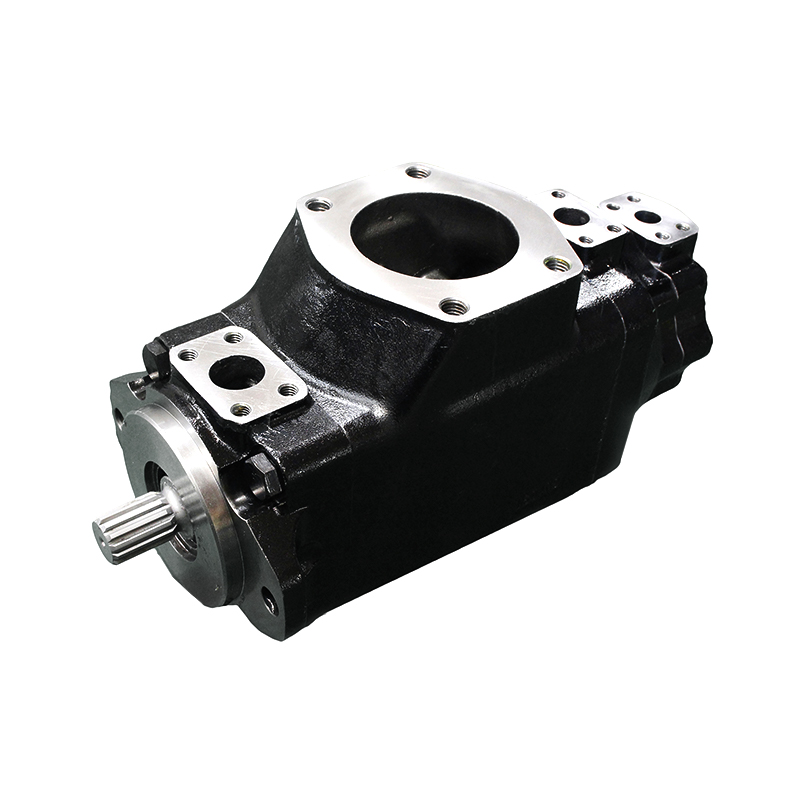
How It Works: The Double Acting Circuit
Understanding the internal circuit of a 12V double acting pump unit helps with both selection and troubleshooting. The complete power unit integrates several components into a single assembly: the electric motor, the hydraulic gear pump, the reservoir, the solenoid-operated directional valve, the relief valve, and the port block — all mounted together on a common base plate.
When the operator presses the "extend" button on the remote pendant, electrical current energizes one solenoid coil in the directional control valve. This shifts the valve spool, directing pump output flow to the A port (the cap end of the cylinder). The piston extends, and fluid displaced from the rod end returns through the B port back to the reservoir. The relief valve on the A port — typically set to 3,000–3,200 PSI on standard units — protects the system from overpressure during extension under heavy load.
When the operator presses "retract," the opposite solenoid energizes, shifting the valve spool the other direction. Pump output now flows to the B port (the rod end of the cylinder), actively driving the piston back. Displaced fluid from the cap end returns through the A port to tank. Because the rod end has less effective area than the cap end — due to the cross-section of the piston rod — the retraction stroke generates less force than the extension stroke at the same pressure. This is why many double acting pump specifications show a lower pressure relief setting on the B port (typically 1,400–1,500 PSI) than on the A port: the lower area on the rod side means adequate retraction force is achieved at lower pressure, and a lower B-port relief setting protects the cylinder rod seals from over-pressurization during retraction.
When neither solenoid is energized, the directional valve centers and both ports are blocked, holding the cylinder in position. The pump motor stops in most standard units, which conserves battery power and reduces heat generation during stationary holds.
Key Specifications to Understand
Comparing 12V double acting pump specifications requires understanding what each parameter means in practical terms. Marketing descriptions alone are insufficient for confident selection.
Motor power (kW or HP): Standard light-duty units use motors in the 1.2–1.6 kW (1.6–2.2 HP) range, suitable for occasional cycle applications with moderate loads. Heavy-duty units range from 2.0 to 3.0 kW (2.7–4.0 HP) and are specified for frequent cycling or heavier cylinder loads. Higher motor power delivers faster cylinder speed at equivalent pressure and provides more thermal reserve for high-cycle applications.
Rated pressure (PSI or bar): The A-port relief valve setting determines the maximum working pressure available for the extension stroke. Most standard units are factory-set at 3,000–3,200 PSI (207–221 bar). Some heavy-duty units reach 3,500 PSI (241 bar). The B-port relief is typically set at 1,400–1,800 PSI. Always confirm that the rated pressure of the pump exceeds your maximum cylinder load pressure by at least 10–15% to avoid continuous relief valve operation.
Flow rate (GPM or L/min): Flow determines cylinder speed — the faster you need the cylinder to move, the higher the flow rate required. Standard compact units deliver 0.8–1.1 GPM (3–4.2 L/min). Higher-output units reach 1.5–2.0 GPM (5.7–7.6 L/min). Calculate required flow using the formula: Flow (GPM) = Cylinder volume per stroke (cubic inches) ÷ 231 ÷ Desired cycle time (minutes).
Reservoir capacity (quarts or liters): The reservoir must hold enough fluid to supply the cylinder's full stroke volume plus a safety margin. A cylinder with a 6-quart displacement per stroke needs at minimum an 8–10 quart reservoir to account for fluid in the lines and thermal expansion. Undersized reservoirs cause overheating by returning hot fluid directly back into the circuit without adequate cooling time between cycles.
Duty cycle: This is perhaps the most under-specified parameter in catalog descriptions. Duty cycle expresses what percentage of time the motor can run continuously before requiring a cooling rest period. A 50% duty cycle motor can run for 3 minutes and must then rest for 3 minutes. Units marketed for intermittent use (dump trailer that cycles once per delivery) can tolerate lower duty cycles than units installed on equipment that cycles repeatedly throughout a work shift. Operating a low-duty-cycle motor beyond its rating causes winding overheating and premature failure.
Common Applications
The combination of 12V compatibility, bidirectional output, and compact self-contained construction makes the 12V double acting pump the standard power source across a wide range of mobile equipment.
Dump trailers and dump trucks: The most common application. The double acting circuit powers the bed up under full load and controls the lowering speed on the return stroke, preventing the bed from slamming down when empty. A flow restrictor on the B port — included on better-quality units — meters the return flow to produce a controlled, damped descent.
Snowplow and blade angle systems: Snowplow manufacturers rely on 12V double acting pumps to control blade angle and lift simultaneously. The powered retraction stroke is essential here because gravity alone cannot reliably return a blade that has been angled against a bank of compacted snow.
Vehicle-mounted cranes and articulating booms: Service trucks, utility vehicles, and recovery trucks use 12V double acting systems to power boom extension, rotation, and stabilizer leg deployment. The ability to hold position under load without continuous motor operation is critical in these applications.
Tipping bodies and refuse vehicles: Agricultural tipping trailers, grain carts, and light refuse vehicles use double acting circuits to control both the raise and lower of the body, with the powered lower stroke providing resistance against sudden load shifts during unloading.
Log splitters and wood processing equipment: Log splitter manufacturers use double acting cylinders to power both the splitting stroke (high force, lower speed) and the rapid return stroke (lower force, higher speed), maximizing cycle rate compared to single acting designs with spring return.
Agricultural and horticultural machinery: Seeders, sprayers, and toolbar equipment on tractors and ATVs use 12V double acting pumps when the vehicle's PTO-driven hydraulic system is unavailable or insufficient for auxiliary implement requirements.
How to Choose the Right 12V Double Acting Pump
Working through the following five parameters in sequence produces a specification that matches the pump to the application. Shortcutting this process is the primary cause of premature pump failure and unsatisfactory system performance. For broader context on hydraulic pump technology and configurations, our range of hydraulic pumps provides a useful reference point for understanding where 12V mobile units fit within the wider product landscape.
Step 1 — Define maximum working pressure. Calculate the load force on the cylinder and divide by the cylinder's effective piston area to determine the required operating pressure. Add 15% margin for friction and line losses, then confirm the pump's A-port relief setting comfortably exceeds this value. If your calculations require sustained pressure above 3,200 PSI, consider whether an industrial-grade piston pump power unit better suits the application.
Step 2 — Calculate required flow rate. Determine the cylinder bore and stroke, calculate the volume per full stroke, and divide by the desired cycle time. If your dump trailer cylinder has a 4-inch bore and a 24-inch stroke, the cap-end displacement is approximately 301 cubic inches (4.9 liters). To complete the extension stroke in 30 seconds, you need approximately 2.6 GPM — which rules out compact 1.1 GPM units and points toward a higher-output 2.0+ GPM model.
Step 3 — Size the reservoir correctly. As a minimum, the reservoir should hold 1.5 times the total fluid volume required for a complete extend-and-retract cycle, plus a 20% thermal expansion margin. For high-cycle applications, increase this to 2× the cycle volume to provide adequate heat dissipation between cycles.
Step 4 — Match duty cycle to the application. Classify your application: intermittent (fewer than 10 cycles per hour with long pauses between cycles) or continuous (more than 20 cycles per hour or extended holding periods). Select a motor with a rated duty cycle appropriate for the higher demand category. When in doubt, specify one duty cycle class higher than calculated — the cost difference between a 50% and a 75% duty cycle motor is small compared to the cost of an early motor replacement.
Step 5 — Verify electrical capacity. A 12V motor drawing 150–200 amps at full load requires heavy-gauge cabling to avoid voltage drop that reduces motor torque and increases heat generation in the wiring. Use 2/0 AWG or larger cable for runs up to 10 feet from the battery, and 4/0 AWG for runs of 15–20 feet. Install an appropriately rated fuse or circuit breaker within 18 inches of the battery positive terminal. A marginal battery or undersized cabling is the leading cause of "new pump won't reach rated pressure" complaints.
Installation and Wiring Essentials
A correctly specified pump that is poorly installed will underperform or fail prematurely. The following installation practices are critical to achieving rated performance and service life.
Mount the unit level or with the reservoir slightly tilted toward the pump inlet. The pump's internal gear set must have reliable fluid supply at all times. Mounting with the inlet side elevated allows air pockets to form above the pump gears, causing aeration and noise. Most units have an arrow or marking indicating the correct reservoir orientation.
Use correct hydraulic hose sizing. The pump's A and B ports are typically SAE #6 (3/8-inch) on standard units and SAE #8 (1/2-inch) on higher-flow units. Under-sizing the hose creates back pressure that robs available cylinder force and generates heat. Keep hose runs as short as practical, with smooth bends rather than tight kinks that create restriction.
Wire the motor directly to the battery with appropriately rated cable. Never wire through a vehicle fuse panel or share the motor circuit with other accessories — the high inrush current on motor start will trip lighter fuses and cause voltage fluctuations that affect sensitive vehicle electronics. Run a dedicated positive cable from the battery positive terminal through a fuse holder to the motor, and a dedicated negative cable directly to the battery negative or a clean chassis ground point as close to the battery as possible.
Fill the reservoir with the correct grade of hydraulic fluid before first use. Most 12V pump units specify ISO 46 or ISO 32 hydraulic oil. Do not use automatic transmission fluid as a substitute — ATF has different viscosity characteristics and additive packages that can swell seals and cause erratic valve operation. Fill to the maximum mark on the sight glass and cycle the system several times with minimal load to bleed air from the lines before applying full working pressure.
Common Problems and How to Fix Them
Most issues with 12V double acting pumps fall into a small number of predictable categories. Identifying the symptom correctly points directly to the cause.
Motor does not start or starts weakly. The most common cause is insufficient battery voltage or inadequate cable gauge. Measure battery voltage under load with a voltmeter — voltage should remain above 11.5V during motor start. If voltage drops below 10V, the battery is either discharged or has insufficient cold cranking capacity for the motor's start current. Check all cable connections for corrosion at the terminals, which adds resistance and reduces available voltage at the motor. A corroded terminal that looks intact from outside can have significant resistance at the contact surface.
Pump runs but cylinder does not reach rated pressure. First confirm that the cylinder is actually at its mechanical stop — a cylinder that still has travel remaining will not build to relief pressure. If the cylinder is at the stop and pressure is still below specification, check whether the relief valve has been accidentally backed off from its factory setting. The relief valve adjustment screw is typically located on the pump body or valve block; check the unit documentation for its location before adjusting. A worn pump that is bypassing internally will also fail to reach rated pressure — measure current draw during stall: a pump that is bypassing draws less current than rated because it is not doing full hydraulic work.
System overheats during normal operation. Check fluid level first — low fluid is the most common cause of overheating in 12V units. If fluid level is correct, the duty cycle may be exceeded: allow the unit to cool and reduce cycle frequency. If overheating persists at correct fluid levels and appropriate duty cycles, the relief valve may be cracking at below its rated pressure, continuously converting pump output to heat rather than delivering it usefully to the cylinder. Verify relief pressure with a gauge at the A port while stalling the cylinder against a hard stop.
Cylinder drifts when solenoid is de-energized. Internal leakage across the directional valve spool is the most common cause. Remove the valve and inspect the spool lands for scoring or contamination. A contaminated spool that does not seat fully in the center position allows fluid to slowly cross between the A and B ports, causing the cylinder to drift. Flush the valve body with clean fluid and reinstall; if drifting continues, the valve requires replacement. For load-holding applications where drift is unacceptable, install a separate pilot-operated check valve or load control valve in the cylinder lines rather than relying solely on the directional valve for load holding.